Tire Export Powerhouse Beyond Cars
How China’s Tire Industry Outpaced Its EV Boom
While the world fixates on Chinese electric vehicles flooding global markets, a far older and less glamorous industry has already mapped the globe. Tires. Nearly a century in the making, this sector operates in near-total public silence—yet its globalization story started two decades before the first car factory broke ground.
A Head Start of Twenty Years
In October 1934, Shanghai’s Great China Rubber Factory produced the country’s first automobile tire under the “Double Coin” brand. At the time, foreign labels owned the market. That single tire punched a hole in their dominance. The company later merged with Zhengtai Rubber, forming what is today Double Coin Tire Group.
China’s auto industry, by contrast, counts its genesis from July 15, 1953, when the First Automobile Works laid its foundation. The twenty-year gap isn’t trivia. Long before any car plant existed, tire makers were already climbing the technical ladder—reverse engineering, importing production lines, and mastering radial tire technology. The tuition had been paid in full.
35% of the World, One Complete Chain
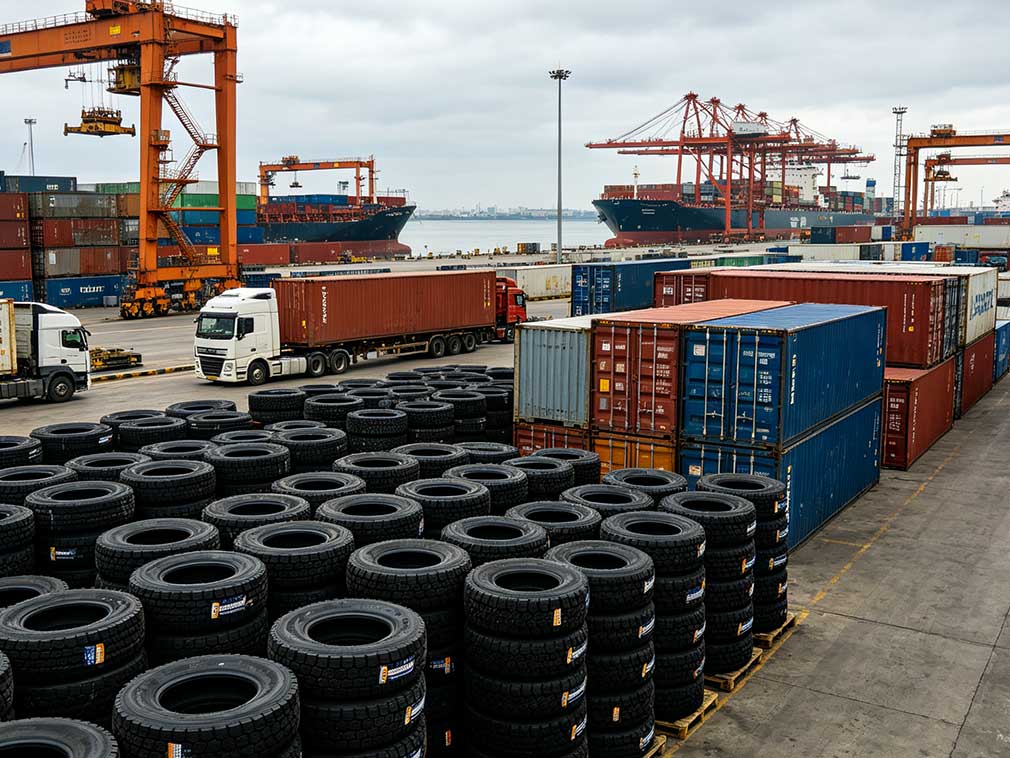
By 2024, China produced roughly 1.17 billion rubber tires, with exports surpassing $20 billion and a global market share hovering around 35%. Shipments reached over 100 countries, with Brazil as the top destination. Names like Zhongce, Linglong, Sailun, Triangle, and Double Coin are fixtures in the global top 75.
Look upstream and downstream: natural rubber processing, carbon black, steel cord, tire building, distribution channels—every link is domestically held. While automakers wrestle with dependencies on high-end chips and core algorithms, tire manufacturers face no such choke points.
And here’s a fact often overlooked: the tire sector has long been forged in open competition. Domestic brands dominate the replacement market and commercial vehicle tires. In plain terms, China’s carmakers grew up inside the greenhouse of joint ventures. Tire companies fought in the open field from day one.
Building Factories Abroad—a Decade Ahead
When the U.S. slapped special safeguard tariffs on Chinese tires in 2009 and the EU followed with anti-dumping duties, the industry didn’t wait. It moved. By the end of 2024, twelve firms including Zhongce, Linglong, Sailun, General Science, and Sentury had erected 27 production bases across four continents—Thailand, Vietnam, Cambodia, Indonesia, Mexico, Serbia, Morocco. In 2024 alone, fifteen companies launched nineteen projects, pouring over 30 billion yuan into new capacity.
This isn’t a simple relocation play. It’s a resilient, cross-regional network. When one market raises tariff walls, orders shift seamlessly to another origin. Thailand serves North America, Serbia cuts into Europe, Mexico leverages the USMCA to enter the U.S. This operational architecture has been refined for over a decade.
The auto industry’s large-scale overseas push, mostly powered by EVs, is a very recent phenomenon. Most factories abroad are still ramping up and ironing out wrinkles.
A Business That Doesn’t Hinge on New Car Sales
Structurally, tires enjoy an advantage automakers can only envy: demand isn’t tied to new vehicle sales. By the end of 2025, China’s car parc is projected to hit 366 million units, according to the Ministry of Public Security. Every one of those vehicles needs fresh rubber on a regular cycle. New car numbers may swing; replacement demand stays stubbornly steady.
Export exposure is also well diversified. In 2024, Latin America, the EU, and ASEAN together absorbed nearly half of total tire exports, with developing nations particularly hooked on Chinese commercial tires. Car exporters, by contrast, live and die by the new-sales cycle. A demand dip triggers a cascade: idle capacity, bloated inventory, strained cash flow.
The Obvious Cracks
The story isn’t all triumph.
In the high-end passenger car OE segment, Chinese brands hold less than 10% of the market. Legacy leaders like Michelin and Bridgestone command roughly 80% of global industry profits through technology and brand equity. Chinese players are stuck in a brutal squeeze: price warfare at the bottom, a glass ceiling at the top.
Profit margins tell a grim tale. Sector profitability shrank from 5.3% in 2020 to under 3% in 2023. In 2024, total profits slid another 8.5% year-on-year, with over half of listed tire companies watching net earnings contract. In some tire-producing provinces, factories cluster so densely that certain industrial parks run at less than 60% utilization. Last year, a record number of tire retail shops shut their doors, crushed by credit-fueled cash crunches.
Two Lanes, One Road
Step back, and a clear pattern emerges. On dimensions of industrial accumulation, supply chain completeness, global footprint maturity, and cyclical resilience, China’s tire sector genuinely runs ahead of its automobile sibling. For nearly a hundred years, it had no protective joint-venture umbrella—just private enterprises scrapping it out in the market.
Yet the tag “big but not strong” still sticks. Frontier material R&D lags. Premium brands haven’t materialized. The OE wall remains largely unbreached.
Going forward, tire makers must storm the high-end OE beach and seize the window opened by EV adoption. Automakers need to accelerate overseas factory construction and absorb local operational know-how. When both industries close their gaps, China’s automotive supply chain will finally possess genuine, battle-tested depth.