
China Scrap Tire Prices August 2026
Narrow price spreads and diverging demand: China’s waste tyre market in early August 2026
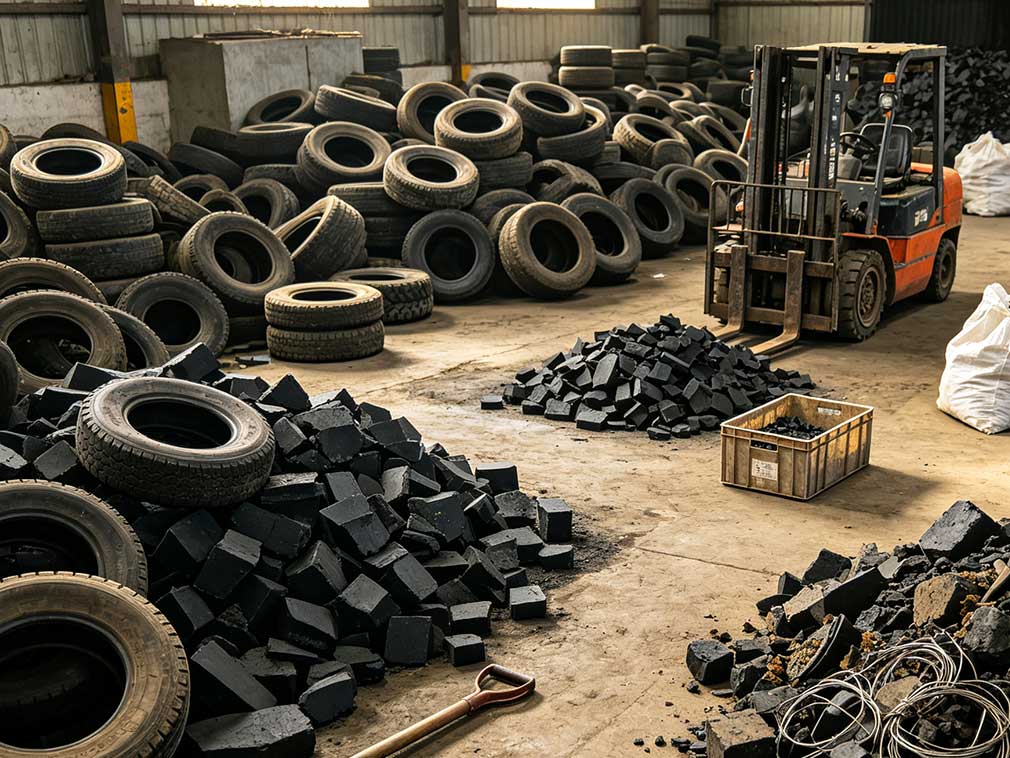
Early August pricing data from China’s waste tyre sector has surprised many in the trade. Rather than the widely expected widening of regional price gaps, quotes for shredded truck and bus tyre rubber blocks (crumb) across eight key provinces have landed in a tight band of RMB 1,650–1,710 per tonne (approximately USD 228–237/tonne). The headline inter-provincial spread is just RMB 60, a margin too thin to cover cross-province freight costs in most cases.
Provincial gaps can be larger than inter-provincial ones
A closer look at the numbers reveals that logistics – not provincial borders – is what really drives pricing. On the same day, Mysteel’s Shandong data showed intra-provincial price differences of RMB 70–80 per tonne. Zouping was quoted at RMB 1,750–1,770/tonne, while Zibo, Jining and Linyi sat at just RMB 1,680–1,700/tonne. The decisive factor is distance to processing plants and who bears the freight, making the standard “which province” lens less useful for procurement decisions.
A critical quotation caveat: ex-works vs delivered
Procurement teams should pay close attention to quotation terms. The widely circulated reference prices above, from trade and distribution channels, are almost certainly on an ex-works basis.
By contrast, Hexun.com on 4 August reported a delivered price for whole-truck-tyre rubber blocks in Zouping, Shandong, at RMB 1,820–1,830/tonne – a premium of well over RMB 100. The gap between ex-works and delivered-to-plant numbers is easily large enough to distort margin calculations, so checking the incoterm behind any headline figure is essential.
Reclaim rubber: a genuinely soft spot
The reclaim rubber sector remains lacklustre. July and August are the traditional off-season, and that seasonal weakness is being felt. Mysteel notes that Shandong reclaimers are showing little buying appetite, with thin trading and a focus on drawing down earlier inventories. 51 Recycling Network points out that new orders for reclaim rubber producers have been sliding since May, with finished goods stockpiling.
Some plants have responded by reducing output or scheduling maintenance. SCI99’s assessment aligns: downstream demand is sluggish, margins for reclaimers are thin, and operating rates cannot gain traction. This is fundamentally a demand-side weakness, not an environmental inspection story.
Pyrolysis is pulling in the opposite direction
In contrast to the reclaim sector, the thermal pyrolysis segment is running firm. Prices for tyre pyrolysis oil have risen, and Hexun’s 4 August report explicitly states that this is “driving increased demand for raw materials such as waste steel wire tyres and rubber blocks.”
The industrial weight behind pyrolysis is also becoming impossible to ignore. Sinopec Circular’s waste tyre pyrolysis oil project completed full-line commissioning in the first half of the year and has already shipped its first commercial product.
Meanwhile, Hubei Hongsheng has filed a record for a RMB 1.5 billion, 500,000-tonne-per-year processing project. With both central state-owned enterprises and local state capital investing heavily, pyrolysis is no longer a niche supplementary route – it is rapidly becoming a co-equal pillar alongside reclaim rubber.
Feedstock supply remains tight
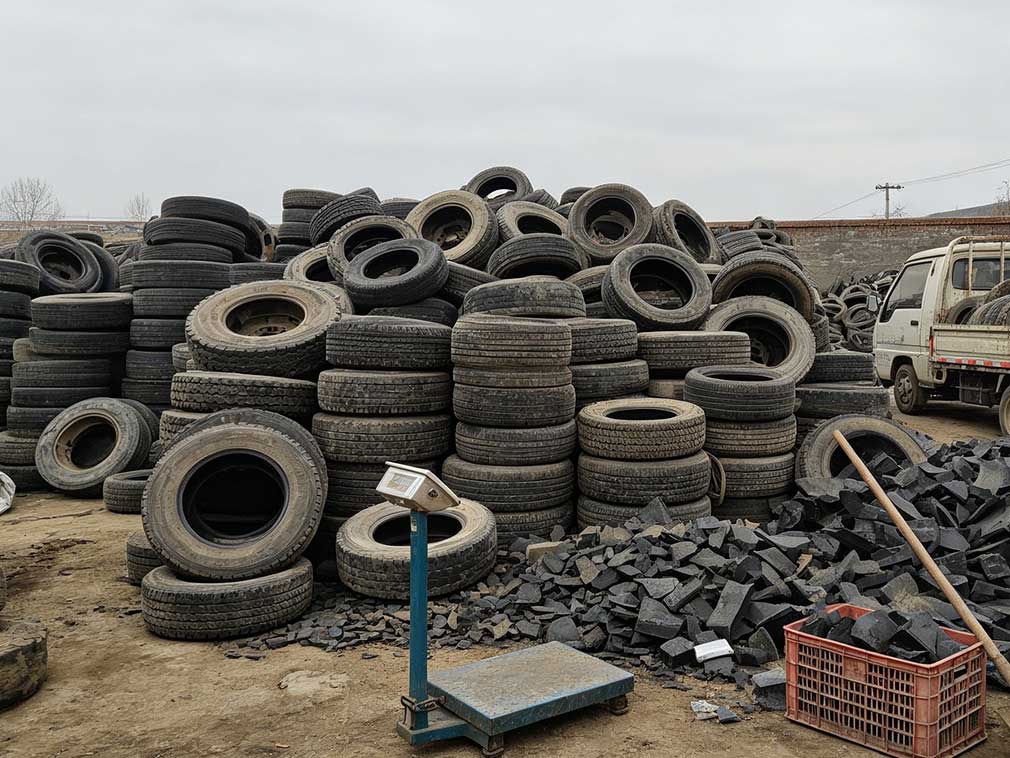
On the supply side, there is broad agreement among agencies: material is scarce. Hot weather and rainfall are disrupting collection operations, keeping output of waste steel wire tyres naturally limited. SCI99 points to tight availability as the factor putting a floor under prices. 51 Recycling Network argues that waste steel wire tyre prices have limited downward room in the third quarter precisely because overall collection volumes are on the low side.
Quality segregation adds another layer. Clean, low-impurity rubber blocks are consistently easy to sell, while the discount on lower-grade, mixed or contaminated material is narrowing – simply because overall supply is so tight that even lower-quality product is finding buyers.
Outlook: soft near term, firmer later in Q3
The consensus across SCI99, 51 Recycling Network and Mysteel points to a Q3 trajectory that is first softer, then firmer.
Early to mid-August is likely to remain a grind. The traditional summer lull in the reclaim rubber chain will keep purchasing activity subdued. SCI99’s forecast places the downside for 9.00-12.00 waste steel wire tyres in Shandong at around RMB 1,700/tonne, with a full-year trading range of RMB 1,650–1,850/tonne and an annual average near RMB 1,750.
By late August and into September, a modest pick-up in downstream offtake is anticipated. Combined with the natural tightening of scrap collections heading into autumn and winter, this should support a moderate price recovery.
For recyclers and traders, the current environment does not favour building inventory. Fast turnover, low stock remains the prudent approach. Key signposts to monitor are: the sustainability of pyrolysis oil prices, the point at which reclaim rubber’s off-season bottoms, the commissioning cadence of the major new pyrolysis capacity, and any resurgence of autumn/winter environmental restrictions.






