
The Hidden Environmental Cost of Electric Vehicle Tires
Electric vehicles are selling like hotcakes. Quiet, fast, and no need for gasoline—it sounds like a good thing for the environment. But tire companies are having a headache lately.
Tires are the only part of a car that comes into contact with the road, making them inherently contradictory—they need sufficient grip, low rolling resistance, durability, and quietness. Engineers spent decades grappling with these issues in the era of internal combustion engines. Then electric vehicles arrived, exacerbating the existing challenges.
How much have electric vehicles pushed tires? Batteries are heavy. The Volkswagen e-Golf has a curb weight of approximately 1,510 kg, while the gasoline-powered Golf VII on the same platform weighs about 1,354 kg—a difference of 150 to 300 kg. The lithium-ion battery pack itself accounts for about 318 kg. Claims of a "400 kg weight" are often seen online, but that figure is exaggerated by about a third.
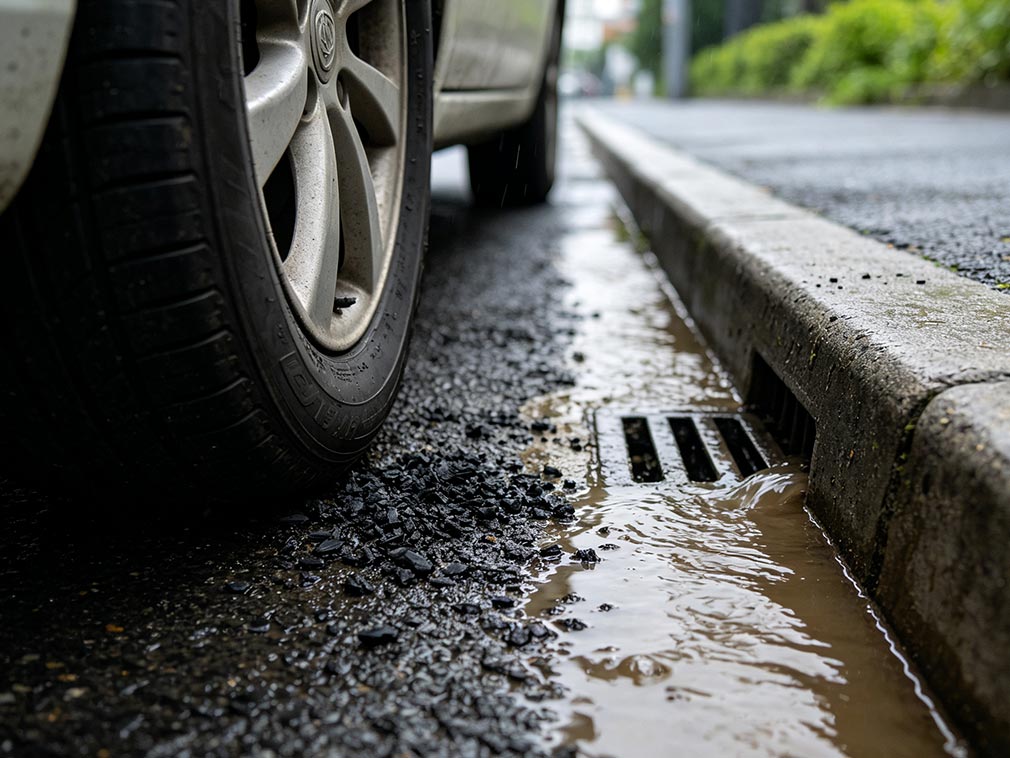
With increased weight, tires need to be even more robust. Independent testing agency Emissions Analytics' tests reveal a clear trend: for every 500 kg increase in vehicle weight, tire wear emissions rise by approximately 21%. Electric vehicles, with their higher instantaneous torque, experience even more particle shedding during acceleration. Overall, electric vehicle tire wear particulate emissions are about 20% higher than comparable gasoline-powered vehicles.
Emissions Analytics conducted a comparison showing that the Tesla Model Y's tire wear was 26% higher than the Kia Niro's. The difference isn't dramatic, but the trend is clear.
What's truly surprising is the order of magnitude
When it comes to vehicle pollution, the public's attention has long focused on exhaust pipes. Emissions Analytics' findings in real-world driving conditions are counterintuitive: under normal driving conditions, the mass of particulate matter generated by tire wear is approximately 1,850 times that of modern gasoline-powered vehicle exhaust.
With 1.5 billion cars worldwide, assuming an average of 4 kg of tire material shed per car per year, approximately 6 million tons of tire material are produced annually. About 10% enters the air and can be inhaled; the majority settles in soil and water. A widely circulated translation mistakenly stated the figure as "60,000 tons," a hundredfold underestimation. The problem lay in the decimal point or unit conversion, but once disseminated, it was difficult to retract.
"For many pollutants, you can effectively capture them with filters or catalysts; but tires are essentially open, there's no way around it," said Nick Molden, founder of Emissions Analytics. He's been in the industry for many years, and his tone carried a hint of helplessness.
The Time Bomb Hidden in Rubber
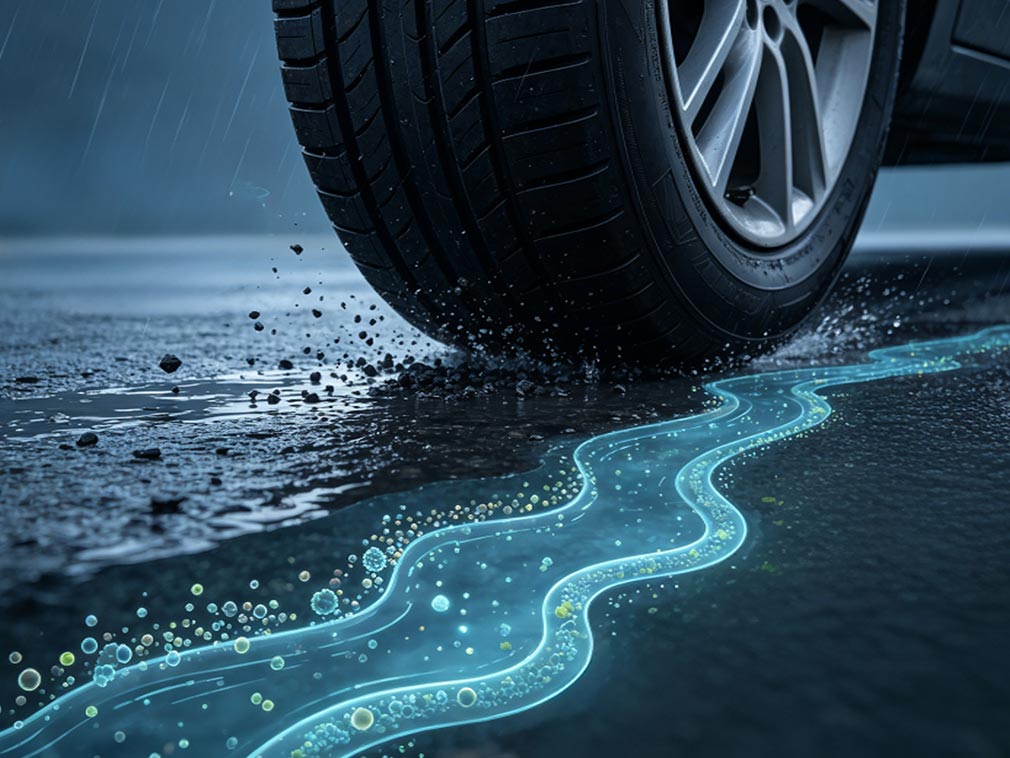
To prevent tire rubber from aging, an antioxidant called 6PPD is commonly added. It's not the most toxic component itself; the real problem lies in what it transforms into when it encounters ozone in the environment—6PPD-quinone.
This chain of harm has only been confirmed in recent years. In 2020, American scientists confirmed that 6PPD-quinone was the direct culprit behind the mass deaths of coho salmon and trout, commonly known in the industry as "urban runoff mortality syndrome." Later, it was discovered that it can be absorbed by the roots of edible plants like lettuce and migrate to the leaves. Later, it was also detected in human blood, urine, and cerebrospinal fluid.
The old translation stated that "6PPD is associated with the death of salmon and trout," which is inaccurate. The direct toxicity comes from its reaction byproducts.
Bridgestone's response was quite restrained: "The mission of the tire industry is to ensure safe, comfortable, and reassuring travel, therefore adding 6PPD to rubber remains essential." The implication is that alternatives are not yet mature.
What are tire manufacturers doing?
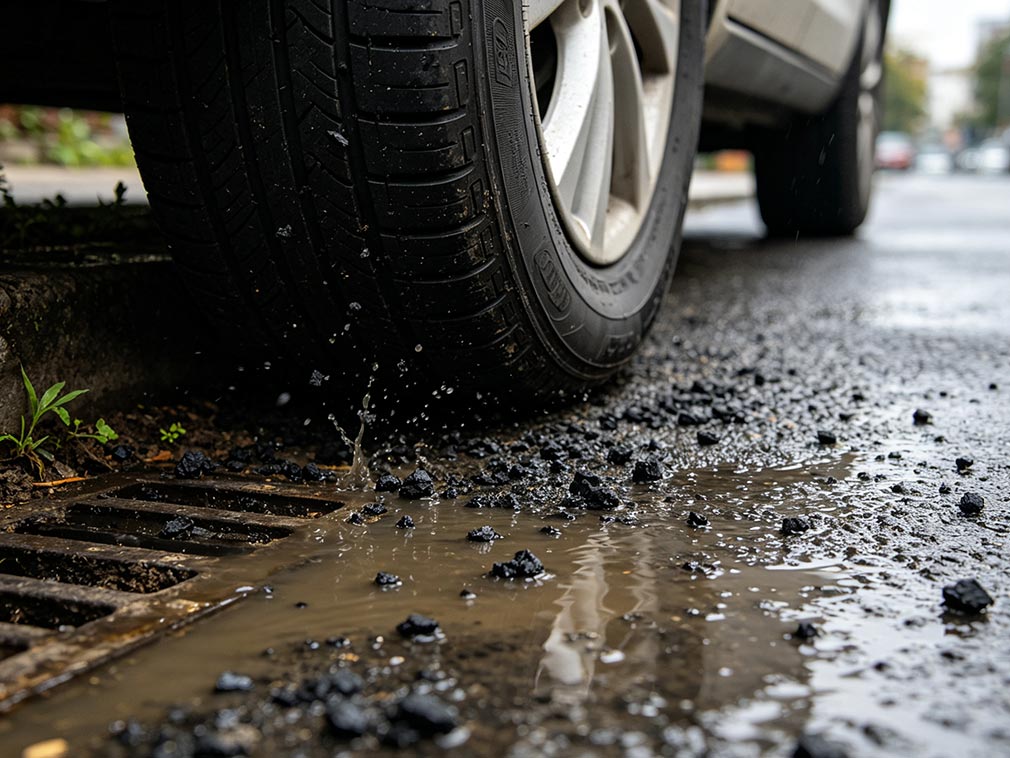
Continental stated that they have been optimizing their products for a long time around three dimensions: lifespan, rolling resistance, and rolling noise—indicators that are precisely what electric vehicles care about most. Some brands have launched tires specifically for electric vehicles, while others have adapted their entire product line to be compatible with both gasoline and electric vehicles.
However, Molden pointed out that different tires can differ by two to three times in VOC toxicity. Overall, leading European brands perform best, while cheap imported tires are often the worst. He suggested establishing a market mechanism to incentivize tire companies to invest in developing better formulations. To put it bluntly, let those who do well make money.
Ordinary people can actually do very little
Three things, none of which cost much.
Don't drive too aggressively. Rapid acceleration and hard braking are the main causes of tire wear; smooth driving significantly reduces particle shedding.
Use tires until their lifespan is nearing its end. New tires shed about twice as many particles in the first few thousand kilometers as they do after the break-in period; frequently replacing tires actually makes them "dirtier."
Choose established brands. In terms of toxicity indicators, top European brands are generally more reliable.
Climate activist Tadzio Müller's attitude is much more radical. He believes that the transition to electric vehicles has been packaged as a "saving the planet" solution, but the problem has never been about the form of power, but about growth itself. "The obvious solution is to drive less and sell fewer cars."
Returning to the original question
Electrification has indeed eliminated pollution from the exhaust pipe. But the pressure hasn't disappeared; it's simply shifted to the tires—each car leaves approximately 4 kilograms of invisible footprints annually, totaling 6 million tons globally, carrying a chemical that can kill salmon, get into lettuce, and be excreted in human urine.
Zero emissions never equal zero pollution.






