
EV Tires: Load, Torque, and Maintenance
EV Tires vs. Conventional Tires: Key Differences and Professional Maintenance Protocols
The rapid adoption of electric vehicles (EVs) has brought their unique tire wear challenges into sharp focus. Quieter operation and instant acceleration are clear advantages, but the specific operating conditions of EVs place far greater stress on tires than conventional internal combustion engine (ICE) vehicles. Higher vehicle weight, instantaneous peak torque, and a near-silent cabin environment mean that tires wear faster and age differently.
Many fleet operators and workshops still apply ICE tire maintenance habits to EVs, leading to premature tire replacement, increased downtime, and avoidable safety risks. Drawing on 2026 tire industry technical standards, OEM maintenance specifications, and real-world service data, this article provides a technical comparison of the two tire categories and outlines dedicated maintenance practices that every automotive professional should adopt.
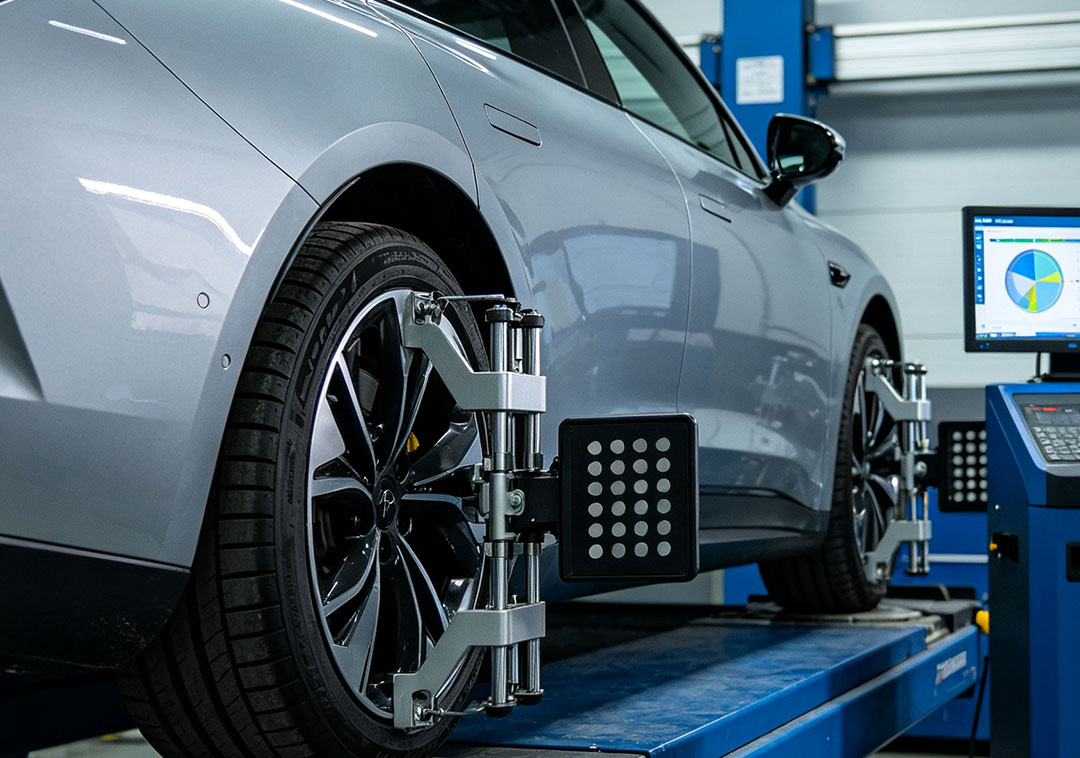
1. Structural Differences: Load Capacity and Sidewall Reinforcement
A battery electric vehicle carries its heavy traction battery pack low in the chassis. In the same vehicle segment, the kerb weight of a BEV is typically 20% to 50% higher than that of its ICE equivalent, with popular mid-size electric sedans adding 300–400 kg over comparable combustion models. This constant, high static load demands a fundamentally different tire construction.
EV-specific tires are engineered with an XL (Extra Load) rating. Their load index is typically 2 to 3 levels higher than that of a standard tire in the same size. Internally, the sidewall is reinforced with multiple high-strength plies and specialized rubber compounds designed to resist deformation and prevent carcass fatigue under continuous heavy loading. Fitting a standard passenger-car tire to an electric vehicle, which is not designed for such sustained loads, will result in rapid shoulder wear, body fatigue deformation, and a significantly elevated risk of sidewall bulge or high-speed rupture over time.
2. Compound Formulation and Performance Priorities
Tire rubber formulations are optimized for the dominant characteristics of the host vehicle. In an ICE vehicle, engine and transmission noise masks a significant portion of road noise, allowing tire development to prioritize wear resistance and fuel economy. Conventional tires therefore feature higher treadwear ratings, often around 500, and deliver a longer service life.
Without engine noise, tire-generated sound becomes the dominant cabin disturbance in an EV. To address this, EV tires utilize softer silica-based compounds and often incorporate a polyurethane foam layer bonded to the inner liner to absorb cavity noise. This acoustic optimization comes at a cost: wear resistance is compromised.
The typical treadwear rating for a mainstream EV tire is approximately 300. Field data confirms that the wear rate of EV tires is 30% to 50% faster than that of ICE tires. Under normal usage, front-axle tires on an electric vehicle often require replacement after 30,000 to 40,000 kilometers, whereas a conventional tire can achieve 60,000 to 80,000 kilometers. Both tire types aim for low rolling resistance—to preserve electric range in one case, and to improve fuel economy in the other—but the specific formulation and construction trade-offs are not interchangeable.
3. Torque Resistance and Tread Pattern Architecture
An internal combustion engine delivers its torque progressively, building power linearly. Electric motors, by contrast, can deliver peak torque from zero RPM. The instantaneous torque output of an EV motor can be two to three times that of a comparable ICE vehicle. Every aggressive start and sharp acceleration subjects the tire’s tread blocks to extreme shear forces.
To withstand this, EV tire architecture features a thicker tread cap, optimized groove geometry with anti-tear properties, and more robust tread block shapes. These design elements resist the chunking, localized rapid wear, and partial tread delamination that would occur if a conventional tread pattern were exposed to the repeated high-torque impulses of an electric drivetrain. Standard ICE tire patterns, designed only for linear force delivery, quickly develop fine cracks, irregular wear patterns, and localized flattening under EV conditions.
4. Aging Cycle and Replacement Criteria
The industry-standard service life recommendation for a conventional tire is five years, provided that tread depth remains above the legal limit and no structural damage is present. Because EV tires operate permanently under higher loads and more frequent stress cycles, their rubber compounds and carcass structures fatigue faster.
In line with major OEM and tire manufacturer maintenance guidelines issued in 2026, the recommended maximum service life for an EV tire is four years. Even if the tread appears serviceable, age-related rubber hardening and the risk of sidewall cracking necessitate replacement once this limit is reached. Owing to their more complex construction and specialized materials, EV tires also command a higher unit price than standard tires of the same size.
Universal Maintenance Practices (Applicable to Both Tire Types)
Certain fundamental tire maintenance procedures remain consistent regardless of the vehicle’s powertrain:
-
Pressure Checks and Visual Inspection: Regularly inspect the tread, sidewalls, and valve stems for cuts, bulges, cracks, or foreign object penetration.
-
Tread Wear Monitoring: Replace tires immediately when the tread wear indicators are flush with the tread surface. Insufficient tread depth severely compromises wet-weather braking.
-
Wheel Alignment and Rotation: Address any vehicle pulling or one-sided tire wear with a professional four-wheel alignment. Implement a regular tire rotation schedule to promote even wear.
-
Driving Habits: Minimize stationary steering, avoid pothole impacts at speed, and approach speed bumps carefully to reduce structural damage.
EV-Specific Tire Maintenance Protocols
Moving beyond general practices, maintaining EV tires requires a stricter, data-driven schedule differentiated from ICE vehicle norms.
1. Increased Tire Pressure Monitoring Frequency and Higher Set Points
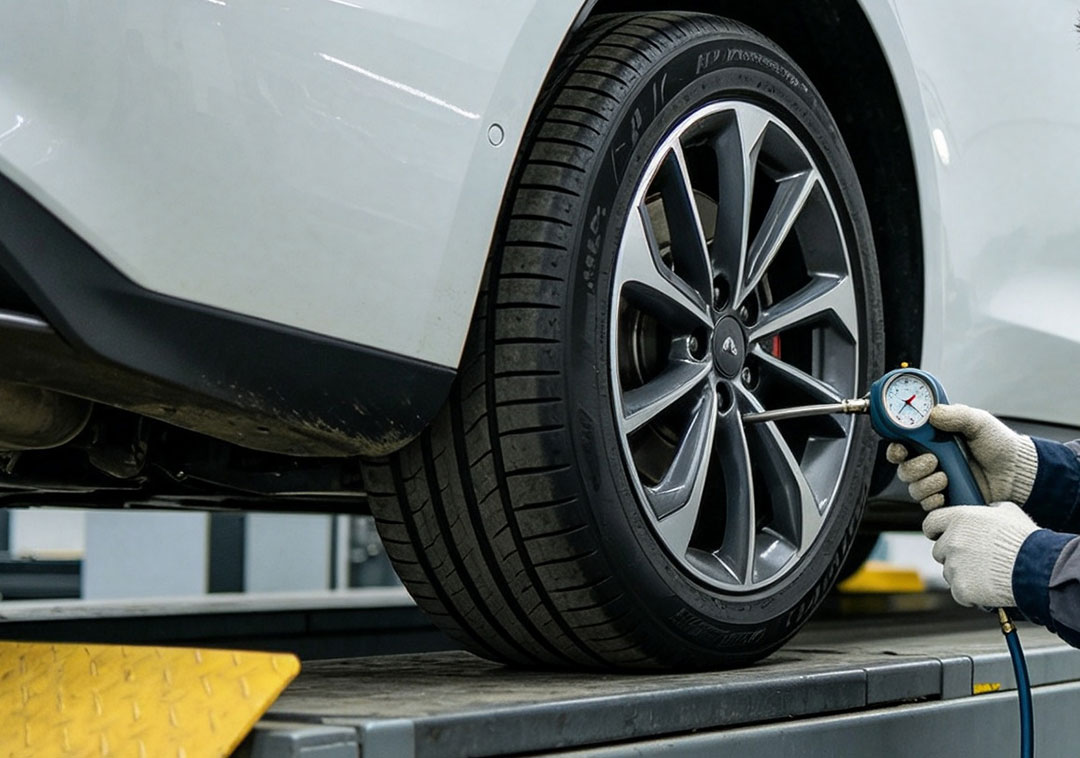
Where a monthly pressure check suffices for an ICE vehicle, the higher mass of an EV causes faster pressure decay. Weekly cold inflation pressure checks are recommended, particularly during seasonal temperature changes. The standard cold pressure for an electric sedan should be maintained at 2.6–2.8 Bar (approximately 38–41 psi), and for an electric SUV at 2.8–3.1 Bar (approximately 41–45 psi)—slightly higher than their ICE counterparts. Underinflation increases rolling resistance, accelerates shoulder wear and carcass fatigue, and can reduce driving range by 5% to 10%. Overinflation reduces the contact patch, compromising wet grip and extending braking distances. All adjustments must be performed cold; never adjust pressures on a hot tire.
2. Shortened Tire Rotation Intervals
The standard 10,000-kilometer rotation interval for ICE vehicles is inadequate for EVs. The front axle of an EV bears the combined load of steering, the majority of braking forces, and a heavy static weight distribution. This leads to a more pronounced wear differential between front and rear axles. A cross-rotation every 6,000 to 8,000 kilometers is required to equalize wear rates and maximize the useful life of the set. During rotation, all embedded stones and debris must be cleaned from the grooves, and the cold pressures must be verified.
3. Driving Habit Discipline to Minimize Instantaneous Wear
While an occasional hard launch in an ICE vehicle has a marginal impact on tire life, every high-torque start in an EV generates a severe shear event on the tread compound. A pattern of frequent full-throttle (“pedal-to-the-metal”) acceleration and high-speed braking can shorten the service life of an EV tire by more than 40%. Maintaining smooth accelerator modulation, steady starts, and progressive braking is the single most effective operational measure to slow wear rates and reduce tire particulate pollution.
4. Strict Adherence to Replacement Cycles and No Tire Mixing
The four-year age limit for EV tires must be enforced, with no exceptions for tread depth alone. When replacement is necessary, only tires that match the vehicle manufacturer’s original specification for EV-specific load capacity and low rolling resistance may be installed. Mounting a standard passenger-car tire to control cost is a false economy; such tires lack the structural load margin and torque resistance required, leading to rapid, irregular wear, reduced electric range, and compromised vehicle safety.
Tires for electric vehicles are not simply a dimensionally interchangeable commodity with their ICE counterparts. They differ fundamentally in load-bearing construction, compound formulation, torque-resistance architecture, and aging characteristics. Standard maintenance habits inherited from the ICE era are insufficient for the heavier, high-torque reality of electric mobility.
For professionals managing fleets or servicing vehicles, implementing EV-specific tire protocols—high-frequency pressure monitoring, shortened rotation intervals, disciplined driving practices, and strict adherence to a four-year replacement cycle—is essential. This dedicated approach mitigates accelerated wear, reduces total cost of ownership, and safeguards operational safety in a rapidly electrifying automotive landscape.






