From the “Magic City” to the “Flower City”: Tracing the Expansion of China’s Cruise Industry Through the Naming of Domestically Built Large Cruise Ships
Recently, the second domestically produced large cruise ship "Aida Huacheng" successfully launched at China State Shipbuilding Corporation's Shanghai Waigaoqiao Shipbuilding Co., Ltd. The name of this giant has attracted attention from all sectors: why is it called "Huacheng"? The answer lies in the home port.
The first domestically produced large cruise ship was named "Aida Modu," with Shanghai as its home port; "Aida Huacheng" is planned to be delivered at the end of 2026 and will be based at Guangzhou Nansha Cruise Home Port, hence named after Guangzhou's nickname "Huacheng."
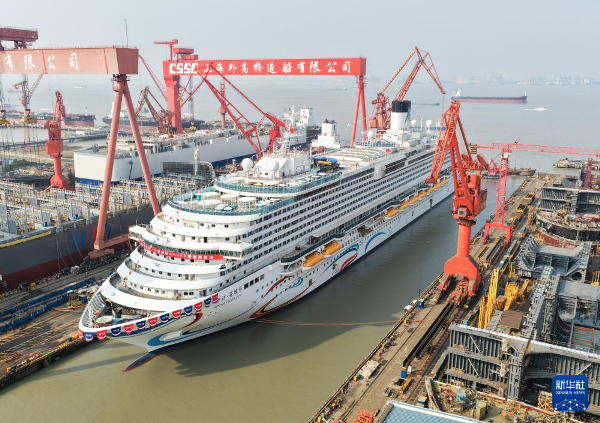
Photo taken on March 19 of the second domestically produced large cruise ship "Aida Huacheng" (drone photo). Xinhua News Agency reporter Ding Ting photographed
From "Modu" to "Huacheng," the naming logic of domestically produced large cruise ships is clear and traceable—"one ship, one city," deeply integrating the ship and the city, highlighting the "dual-wheel drive" layout of China's cruise industry.
Since its opening in 2011, Shanghai Wusongkou International Cruise Port has become an important window for the construction of Shanghai International Shipping Center. After the first domestically produced large cruise ship "Aida Modu" enters market operation in 2024, domestically produced cruise ships and local home ports will achieve "mutual pursuit," with brand effects stacking, making China's cruise industry attract worldwide attention.
The choice of Guangzhou Nansha as the home port for the second domestically produced large cruise ship also holds deep significance. Guangzhou is one of the starting points of the ancient Maritime Silk Road, and the Pearl River Delta region has a profound maritime cultural heritage and a broad space for cultivating cruise tourists. Using Nansha as the home port allows for deep cultivation of the South China market and expansion of Southeast Asia and Northeast Asia routes, echoing Shanghai.
The cruise economy has never been just about shipbuilding. The industry generally believes that the cruise industry has a 1:14 driving effect, from one ship to one port, and then to an entire industrial chain, the cruise economy takes root and sprouts on broader land.
As the home port location of "Aida Modu," Shanghai Baoshan has achieved a transformation from "steel flowers" to "waves," with the once gray industrial shoreline now becoming a waterfront space integrating ecology, commerce, and cultural tourism. During this year's Spring Festival holiday, Shanghai Wusongkou International Cruise Port received over 48,000 inbound and outbound passengers, and the adjacent waterfront commercial complex "Shanghai Maritime World" saw an 80% increase in visitor traffic year-on-year.
In the upstream industry, Baoshan is accelerating the construction of Shanghai International Cruise Human Resources Service Base, promoting cruise crew training, ship supply market cultivation, and local talent development. In October 2025, the Shanghai International Cruise Human Resources Service Alliance was officially established, initially gathering 31 units, covering government, cruise companies, colleges, and human resources service agencies, forming a new pattern of "government-school-industry-enterprise" collaborative education. In the ship supply field, cruise direct supply materials achieve full-process closed-loop operation, and the local supply chain system is rapidly being constructed.
The same development logic is unfolding in Guangzhou. With the delivery and operation of "Aida Huacheng" at the end of 2026, the Pearl River Delta cruise consumption market is expected to accelerate its release, forming a new growth pole for the cruise industry covering South China and radiating Southeast Asia.
The story of the cruise industry ultimately falls on cities. From Shanghai to Guangzhou, from "Modu" to "Huacheng," the naming and layout of domestically produced large cruise ships witness not only breakthroughs in shipbuilding but also the upgrading of Chinese city functions.
On March 20, China State Shipbuilding Corporation and China Travel Group signed a "Memorandum of Cooperation on New Large Cruise Ship Construction Projects" in Shanghai. The two parties will conduct in-depth cooperation around "2 real ships + 1 optional ship," aiming to deliver the first independently designed and constructed cruise ship by the end of 2030. The launch of the new shipbuilding plan will also drive new operational deployments, meaning more cruise home ports will benefit, and the industrial map of domestically produced large cruise ships will further extend.
"The cruise itself is a carrier, witnessing the enhancement of a major country's manufacturing strength and carrying people's yearning for a better life," said Chen Gang, the on-site commander and chief designer of the domestically produced large cruise ship project. When this giant ship named "Huacheng" sails into the sea, it carries not only a ship of tourists but also the dream of China's cruise industry moving from "single-point breakthrough" to "cluster rise." (Reporters Zhou Xinyi, Wang Chenyang)
-
A new round of cross-sea transportation capacity upgrades has been launched for the Qiongzhou Strait.3436
-
Pinglu Canal prepares for pre-launch "comprehensive assessment"3855
-
"Thousands of light boats" race with a hundred sails.3026
-
Ningbo Maritime Authorities Fully Safeguard the "Lifeline" of Ships3994
-
Keeping a Close Eye on Flood Season and Summer Safety: Tianjin Xingang Maritime Bureau Collaborates with Multiple Parties to Strengthen Water Safety Barriers4716